Open Problems
We have a problem situation and know what a feasible solution is. Now we can sift through possibility space. But what if that space has no clear boundary—and keeps changing?
Central to Mong Kok, by metro alone
A1. Find the shortest route from Central to Mong Kok in Hong Kong, using only the metro.
With a metro map, a feasible solution to A1 is easy to find; in this case it is also the unique optimum. This is the map from the original essay. Click two stations—the first sets the origin, the second the destination—or use the menus. On a phone, swipe the map sideways.
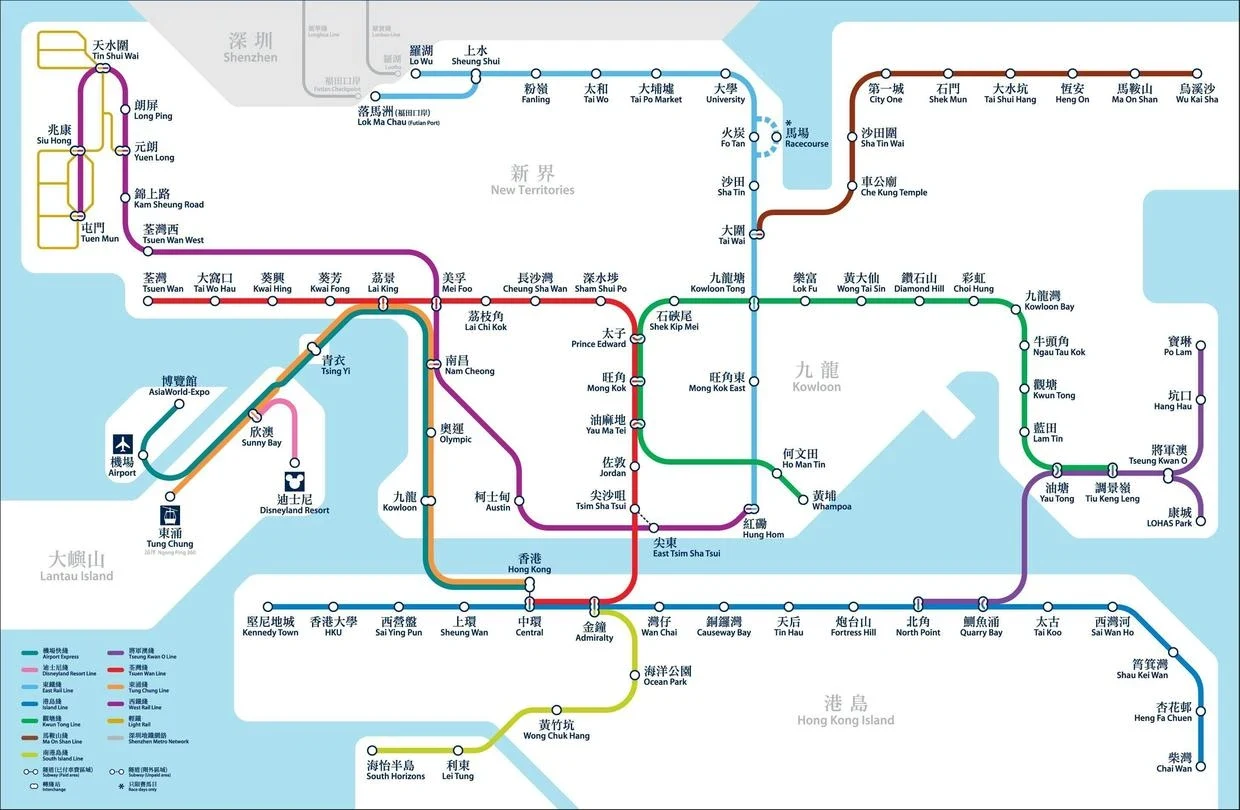
Even “shortest” needs a criterion: time, transfers, or stops? That is the standard discussed in Part 2. For A1, all three lead to the same Tsuen Wan Line route. The constraints are tight and the possibility space is small.
Any way across
A2. Find the shortest route from Central to Mong Kok in Hong Kong, with no restriction on how you travel.
Remove the metro-only restriction and buses, taxis, ferries, walking plus swimming, helicopters, and combinations all enter the possibility space. An open problem is partly defined by its vast possibility space. The other part is harder: that space can change. If teleportation is invented one day, should it count too?
Enable modes of travel one by one to expand the route list. Then answer questions the original problem left unstated and watch it shrink again. The travel routes reflect real journeys; the coastline is traced from OpenStreetMap. Teleportation is a hypothetical option.
Open problems arise fundamentally from incomplete information—about the problem itself and about the solver. A1 and A2 are both vague: they specify modes of travel but no budget, no traveler, and no swimming speed. Even “no restriction on travel” is open-ended. And even with a complete problem statement, a solver’s understanding may be limited. As that understanding improves, the subproblems and representations drawn from the original problem can change.
The four follow-up questions illustrate the original essay’s second strategy: ask questions about the problem itself. Ask its author for clarification and make constraints explicit. Problem formulation and solution become a feedback loop, rather than a one-way pipeline.
You do not need an exact speed
The first strategy for incomplete information is to keep the big picture. For A2, speed is the clearest distinguishing feature. Exact kilometers per hour are excessive for this journey; rough speed bands may suffice. Sometimes even those are unnecessary: we only need to know which is faster. Successive simplifications shrink the possibility space using prior knowledge about speed.
Lower the precision and see which comparisons remain possible.
When the gap is large, a rough speed band is enough. When it is small, simplification can erase it. Metro and taxi both travel at “tens of kilometers per hour,” so the bands do not distinguish them. Return to finer information, or accept a near tie and compare something else, such as traffic exposure. “Order only” needs the least information, but assumes you already know the ranking. The closer two speeds are, the less reliable that order becomes.
For the person posing a problem, incomplete information often depends on shared prior knowledge—in other words, implicit conditions. Used well, shared assumptions save communication. Used poorly, they can be disastrous: what we assume is shared often is not.
What is falsified is the whole conjunction
Implicit conditions connect to Popper’s principle of falsifiability in the philosophy of science. Holists point out that a conditional statement p → q(if p, then q) is more fully written as (p ∧ a1 ∧ a2 ∧ ⋯) → q, a1, a2 are unstated premises. Observing ¬q(q did not occur) does not establish ¬p, only ¬(p ∧ a1 ∧ a2 ∧ ⋯): at least one of the conditions is false, but we do not know which.
The original essay mentions Neptune. Here are two astronomical cases with the same logical form and opposite outcomes. In both, the French astronomer Le Verrier used the same approach. Choose for him: when a prediction fails, which premise should you doubt?
The form is identical: theory + implicit premises → prediction; the prediction fails. For Uranus, the faulty premise was “no unknown planet,” leading to Neptune. For Mercury, the same reasoning led to the nonexistent Vulcan. The problem lay in the theory, eventually resolved by general relativity. From ¬q alone, you cannot tell which premise to blame.
Ideally, a theory can—and must—make its premises explicit. An overlooked condition such as Neptune is not itself a flaw in falsifiability, although falsifying only the whole conjunction seems less informative for scientific progress. Perhaps scientific theories, too, should try to keep their questions from being open-ended: as a theory matures, more constraints become explicit.
One hands-on question in each essay
- 1
The Problem Situation
One square in two drawings, the hidden arrow, search trees, representation, and design.
- 2
Feasible Solutions
Six peeling questions, the water-jar experiment, taking scissors apart, and a pull cord.
- 3
Open Problems
This page: metro routes, unrestricted travel, the big picture, and falsifying a conjunction.
- 4
Choice and Optima
The trolley problem, a balance of values, two thousand possible yous, preference systems, and cycles from changing criteria.
- 5
The Limits of Measurement
From the March 2026 proposal: similarity, classification, and theory-laden observation.
- 6
Duck Typing as a Strategy
Ask what it can do, not what it is. Work with behavioral data and let users set their own weights.
- 7
Engineering Practice
Test environments as counterfactual explorers, dual sensors, and Bayesian Safety.