Problem Situation
The same problem can become harder or easier depending on how it is presented. This essay makes one point: how a problem is presented determines how far you have to travel to solve it.
This series began with “Factors That Affect Problem Solving,” a passage in the People’s Education Press textbook General Psychology (called “the textbook” below). It lists seven factors, each worth thinking about at length:
An arrow is hidden in the background lines. Move your mouse (or tap on a phone) to brush away the irrelevant lines.
One square, two drawings
The textbook’s first example: a circle has a radius of 2 cm. Find the area of the square circumscribed around it. A and B show the same problem; only the radius points in a different direction—diagonally down and right in A, horizontally right in B. Why is B easier?
Drag the orange endpoint, tap anywhere on the circle on a phone, or rotate with the arrow keys.
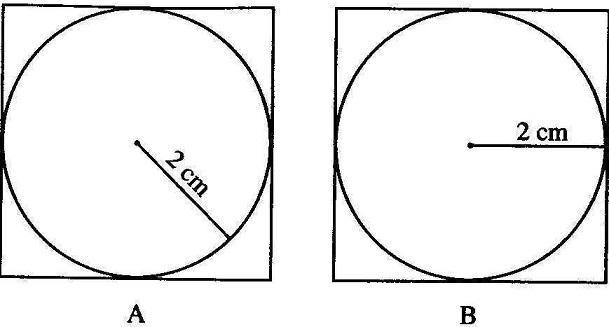
The textbook explains that the stimulus patterns in the two situations are differently aligned with what we already know. The key is that the square’s side is twice the radius. B makes it obvious that 2 cm is half a side. A requires you to recall one more fact—the distance from the center to any point on the circle is the radius—then mentally turn A into B before reaching the same conclusion.
That extra step accounts for the difference in difficulty. It makes “intuitive” or “obvious” more concrete: intuitive means one fewer step.
Find the arrow
The second example asks you to find a simple shape inside a complex one. The hollow arrow at the top left is hidden in the grid and diagonal lines at the bottom right. The point: too little information can make a problem harder, but so can too much.
The puzzles below follow the original construction. Every edge of the arrow lies on a grid line or a 45° diagonal. Lines running through it blend its outline into the pattern. When you find it, click its tip. Start at the easiest level and advance after three successes, or adjust “Irrelevant lines” yourself. Each round’s time appears on the chart.
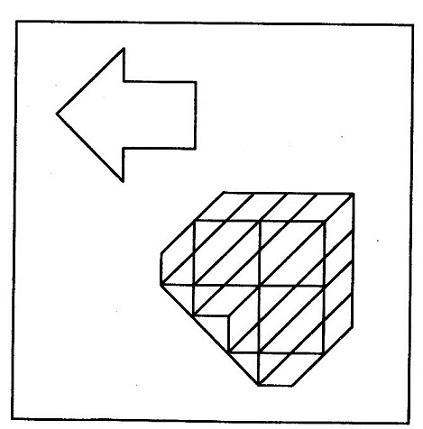
What does “too much information” mean? I think the problem is not redundant information, but irrelevant information. The other lines have nothing to do with finding the arrow, yet they keep interfering. You have to resist that interference throughout the search, so the task becomes harder.
The color switch adds a different kind of information: relevant but redundant, since the shape alone is enough to identify the arrow. Switch it on and the search usually becomes much faster.
Solving a problem means finding a path through possibility space
This suggests a broader point: to some extent, every well-defined problem can be treated as a search problem. We often break a problem into subproblems. Solving them and reaching an answer resembles finding a path through a tree or network. At each node, you choose which child to try next.
The leaf labeled “Answer” is the solution. A node’s brightness represents your estimate that it leads there: brighter means more promising. Dashed circles look less promising and are tried after brighter nodes. At each step, the search tries the brightest child first.
- Too little relevant information: too few children look promising. More precisely, their expected utility falls below your decision threshold, so you must try them almost by brute force. Anyone who has taken an IQ test may recognize this.
- Too much irrelevant information: too many children look promising. Interference obscures differences in expected utility, making it harder to choose.
- Redundant relevant information: there are many options, but overlapping clues help distinguish their expected utilities and reveal a shorter path.
The textbook makes three points about the problem situation. The first concerns the spatial positions of elements. More generally, it concerns distance between elements—in size, shape, color, space, or time—and thus quantifiable relationships. The square and arrow examples explain the other two points.
Change the representation, and a straight line is enough
The original essay ended with a figure from Deep Learning: two representations of the same classification problem. Machine learning calls this representation; in this series, it is the problem situation.
There are two classes: blue dots cluster in the center, surrounded by green triangles. Try separating them with a straight line. Drag either endpoint, then switch to polar coordinates and watch the points move into the arrangement on the right of the original figure.
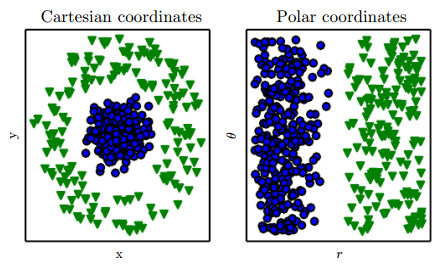
In Cartesian coordinates, the triangles surround the blue dots, so no straight line separates them completely. In polar coordinates, the horizontal axis is distance r from the center; a vertical line separates the classes. The data have not changed, only the way we look at them. For a solver that can only draw straight lines, the representation determines whether the problem is impossible or immediately solvable.
Design lays an optimal path to every function
What does the problem situation have to do with design? Here I set aside art and aesthetics and focus on usability—interaction more than visual design. The purpose of this kind of design is to solve problems.
In software interaction design, the central challenge is to convey the right information through interactive elements, creating an optimal path to every function. Drawing the radius horizontally saves a step. Removing irrelevant lines or coloring the target reduces interference and adds useful redundancy. Changing the representation can turn an impassable route into a straight line.
“Optimal” might mean maximum usability, or a more complex value function that also includes the software vendor’s profit. That makes real interaction design challenging. Value functions are the subject of Part 4.
One hands-on question in each essay
- 1
The Problem Situation
This page: one square in two drawings, the hidden arrow, search trees, representation, and design.
- 2
Feasible Solutions
Six peeling questions, the water-jar experiment, taking scissors apart, and a pull cord.
- 3
Open Problems
Metro routes, unrestricted travel, the big picture, and falsifying a conjunction.
- 4
Choice and Optima
The trolley problem, a balance of values, two thousand possible yous, preference systems, and cycles from changing criteria.
- 5
The Limits of Measurement
From the March 2026 proposal: similarity, classification, and theory-laden observation.
- 6
Duck Typing as a Strategy
Ask what it can do, not what it is. Work with behavioral data and let users set their own weights.
- 7
Engineering Practice
Test environments as counterfactual explorers, dual sensors, and Bayesian Safety.